

Requesting Resources
Resource requests
Resources are obtained by sending a ResourceRequest to a provider. A request usually specifies a resource type rather than a concrete name. This requires a consistent way to define resource types for queries.
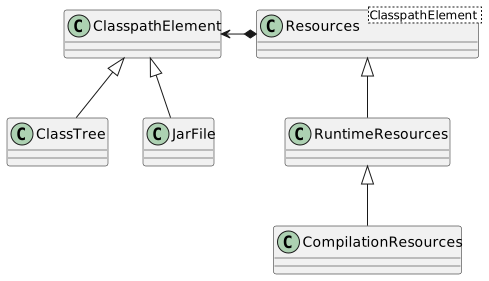
Consider the Java classpath as an example. A Java classpath consists of elements that may either be JAR files or directory trees containing class files (denoted on the classpath by their root directory).
By using CodeContribution as common supertype for JAR files and class trees, we can ask for resource type CodeContribution. Requests for this type are handled by providers for JAR files as well as by providers for class trees.
A commonly available resource that all generators must support is “Cleanliness”. Requesting this resource type from a generator makes it remove all resources that it has created.
Admittedly, this pushes the concept of “everything being a resource” to its limits. It solves the problem of cleaning up after a build. Depending on one’s point of view, “cleanliness” may represent the absence of something, but it can also be regarded as a resource that can be provided.
Resource providers
Resources are provided by
ResourceProviders via
their SPI.
The SPI’s
provide
method must never be invoked directly. Instead, requests must be passed through
the BuildContext’s
resources
method. This allows the BuildContext to synchronize requests and
cache results. To simplify the invocation,
ResourceProvider
defines a method
resources
that performs the invocation via the build context and makes this mechanism
transparent to the user.
The BuildContext invokes the
provide
method asynchronously and wraps the resulting Future in a Stream that
calls the Future’s get method only when this “wrapper Stream” is
terminated. This makes the invocation of BuildContext.resources non-blocking.
The “wrapper Streams” can be freely passed around in a
Project’s constructor,
but they must never be terminated in this context. Effectively, the
first termination of a such a “wrapper Stream” ends the configuration
phase and starts the build phase.
Projects as resource providers
The resources provided by a Project do not only depend on the type of resource requested, but also on the providers that the project selects when forwarding the request. This is controlled by the intents associated with the request via using.
Certain combinations of requested type and intents map directly to
concepts commonly used in other build tools. For example, a request
for code contributions using Supply and Expose yields the classes
produced by the project together with the resources used to create them.
When a project serves as a build dependency, this result constitutes
the project’s API.
More details on combining intents with resource requests can be found in the class documentation of Project.
Requesting resources from the command line
Specifying resource types as Java types works well within a build configuration. On the command line, however, this approach would be rather cumbersome.
For this reason, the root project’s constructor can define aliases for resources that may be used as command arguments when invoking the JDrupes Builder. This is illustrated by the following sample project code:
        // Command arguments
        commandAlias("build", of(new ResourceType<AppJarFile>() {}).usingAll());
Note that the command argument “clean” is predefined and can always
be used to request
“Cleanliness”.