Interface Project
- All Superinterfaces:
ResourceProvider
- All Known Subinterfaces:
RootProject
- All Known Implementing Classes:
AbstractProject, AbstractRootProject, BootstrapBuild, BootstrapRoot
Projects are used to structure the build configuration. Every build
configuration has a single root project and may contain sub-projects.
The root project serves as the entry point for the build. Resources
provided by the builder are typically provided by the root project,
which acts as the central access point of the build configuration.
Projects are ResourceProviders that obtain resources from related
ResourceProviders. Conceptually, a project acts as a router for
requests and resources, with its behavior depending on the intended
usage of the resources obtained from the providers registered as
dependencies. The intended usage is indicated by the Intent that
attributes the relationship between a project and its related
resource providers.
Attributing relationships to providers
Intent Supply

Resources from a provider added with Intent.Supply are made available
by the project to entities that depend on it. Intent.Supply implies
that the resources are generated specifically for the project,
typically by a Generator that belongs to the project.
Intent Consume and Reveal
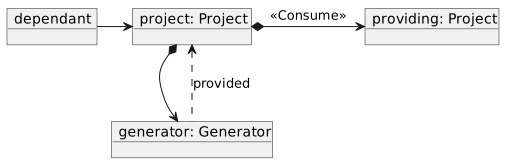
Resources from a provider added with Intent.Consume or
Intent.Reveal are typically used only by a project's generators.
If a provider is added with Intent.Reveal, its resources are also
provided by the project when they are explicitly included in a
request.
Intent Expose
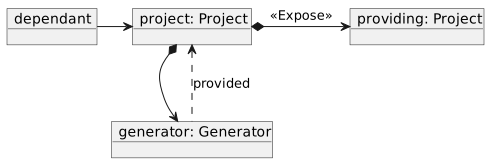
Resources from a provider added with Intent.Expose (typically
another project) are used by a project's generators and are also
provided by the project to entities that depend on it.
Intent Forward
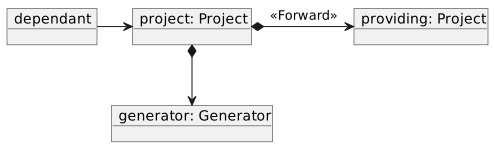
Resources from a provider added with Intent.Forward (typically
another project) are provided by the project to entities that depend
on it. These resources are not intended to be used by the project's
generators. This cannot be enforced, however, as generators may still
access them via providers().
Behavior as resource provider
In its role as a ResourceProvider, a Project
provides resources obtained from its
dependencies. A ResourceRequest controls to which dependencies a
request is forwarded by including the respective Intents in the
set returned by ResourceRequest.uses().
Concepts from other build tools, such as Gradle’s dependency
configurations, can be mapped to resource requests for code
contributions using sets of Intents as follows:
| Intent \ Config. | Api | Implementation | Compile only | Runtime only |
|---|---|---|---|---|
| Supply | X | X | ||
| Consume | X | |||
| Reveal | X | |||
| Expose | X | X | ||
| Forward | X |
To ensure consistent results, a project adjusts a request before
forwarding it to a dependency of type Project (typically a
sub-project). If the request uses Consume or Expose, Consume
is removed and Expose and Supply are added. The reason is that,
regardless of how a sub-project contributes to another project, the
resources it contributes are always those that are part of its API.
To avoid misuse of Intents, all intents are removed from a request
before it is forwarded to a dependency that is not a project.
Factory method for resources
As a convenience, this interface also defines a shortcut for creating
Resources.
-
Method Summary
Modifier and TypeMethodDescriptiondefault PathReturns the directory where the project'sGenerators should create the artifacts.default <T extends ResourceProvider>
Tdependency(Intent intent, Function<Project, T> supplier) Uses the supplier to create a provider, passing this project as argument and adds the result as a dependency to this project.dependency(Intent intent, ResourceProvider provider) Adds a provider that contributes resources to the project with the given intended usage.Returns the project's directory.default <T extends Generator>
TUses the supplier to create a provider, passing this project as argument and adds the result as a generator to this project.Adds a provider to the project that generates resources which are then provided by the project.<T> Tget(PropertyKey<T> property) Returns value of the given property of the project.default StringReturns the project's name and its directory appended in parentheses.Returns the parent project.Returns the instance of the given project class.Return a provider selection without any restrictions.Return a provider selection that is restricted to the given intents.default ProviderSelectionReturn a provider selection that is restricted to the given intents.default StringreadString(Path path) Convenience method for reading the content of a file into aString.default Pathrelativize(Path other) Short fordirectory().relativize(other).Returns the root project.<T> Projectset(PropertyKey<T> property, T value) Sets the given property to the given value.Methods inherited from interface ResourceProvider
context, name, of, resources
-
Method Details
-
rootProject
-
project
-
parentProject
Returns the parent project. The root project has no parent.- Returns:
- the parent project
-
directory
-
nameWithDirectory
Returns the project's name and its directory appended in parentheses. Appending the directory is omitted if it's name equals the project's name.- Returns:
- the string
-
buildDirectory
Returns the directory where the project'sGenerators should create the artifacts. This is short fordirectory().resolve(get(BuildDirectory)).- Returns:
- the path
-
generator
Adds a provider to the project that generates resources which are then provided by the project. For "normal" projects, the generated resources are assumed to be provided to dependents of the project, so the invocation is shorthand for
dependency(Intent.Supply, generator).For projects that implement
MergedTestProject, generated resources are usually intended to be used by the project itself only, so the invocation is short fordependency(Intent.Consume, generator).- Parameters:
generator- the provider- Returns:
- the project
-
generator
Uses the supplier to create a provider, passing this project as argument and adds the result as a generator to this project. This is a convenience method to add a provider to the project by writing (in a project's constructor):
generator(Provider::new);instead of:
generator(new Provider(this));- Type Parameters:
T- the generic type- Parameters:
supplier- the supplier- Returns:
- the project for method chaining
-
dependency
Adds a provider that contributes resources to the project with the given intended usage.
While this could be used to add a
Generatorto the project as a provider withIntent.Supply, it is recommended to use one of the "generator" methods for better readability.- Parameters:
intent- the dependency typeprovider- the provider- Returns:
- the project for method chaining
- See Also:
-
dependency
Uses the supplier to create a provider, passing this project as argument and adds the result as a dependency to this project. This is a convenience method to add a provider to the project by writing (in a project's constructor):
dependency(intent, Provider::new);instead of:
dependency(intent, new Provider(this));- Type Parameters:
T- the generic type- Parameters:
intent- the intentsupplier- the supplier- Returns:
- the project for method chaining
-
providers
Return a provider selection without any restrictions.- Returns:
- the provider selection
-
providers
Return a provider selection that is restricted to the given intents.- Parameters:
intents- the intents- Returns:
- the provider selection
-
providers
Return a provider selection that is restricted to the given intents.- Parameters:
intent- the intentintents- the intents- Returns:
- the provider selection
-
relativize
Short fordirectory().relativize(other).- Parameters:
other- the other path- Returns:
- the relativized path
-
set
Sets the given property to the given value.
Note that there is no way to enforce at compile time that the type of the value passed to
setmatches the type of the property. An implementation must check this at runtime by verifying that the given value is assignable to the default value.- Type Parameters:
T- the value's type- Parameters:
property- the propertyvalue- the value- Returns:
- the project
-
get
Returns value of the given property of the project. If the property is not set, the parent project's value is returned. If neither is set, the property's default value is returned.- Type Parameters:
T- the values type- Parameters:
property- the property- Returns:
- the property
-
readString
Convenience method for reading the content of a file into aString. The path is resolved against the project's directory.- Parameters:
path- the path- Returns:
- the string
-